

Skipping proper training feels like a shortcut until your new hire makes a costly compliance mistake in week two, or your best candidate quits at the 60-day mark because they never felt set up to succeed. The numbers back this up: companies with comprehensive programs see 218% higher income per employee, 24% higher margins, and 17% higher productivity. For small businesses, that gap between "winging it" and "doing it right" is enormous. The good news? You don't need a corporate L&D department or a six-figure budget to get the basics right. You just need a clear plan.
Table of Contents
- Understand prerequisites: what you need before building a program
- Step-by-step: how to create a basic employee training program
- Special focus: onboarding, compliance, and skills development
- Measuring and improving results
- Why simple, practical training wins for small businesses
- How OnboardingGenie can help streamline your employee training basics
- Frequently asked questions
Key Takeaways
| Point | Details |
|---|---|
| Start with needs analysis | Identify actual skill gaps before designing any employee training program. |
| Mix low-cost methods | Shadowing, SOPs, and mentorship often work better than expensive platforms for small teams. |
| Personalize by role | Tailor onboarding, compliance, and skill modules for greater engagement and results. |
| Track more than attendance | Use KPIs like retention, error rates, and productivity to measure true training ROI. |
| Iterate and improve | Pilot programs, gather feedback, and adjust content for continuous growth and effectiveness. |
Understand prerequisites: what you need before building a program
Having seen why the basics matter, let's cover what you need in place before you begin. Jumping straight into building training content is one of the most common mistakes small business owners make. You end up creating materials that don't match actual skill gaps, and the whole effort gets shelved after a few weeks.
Start with your business outcomes. What problem are you actually trying to solve? Lower turnover? Faster time-to-productivity for new hires? Fewer compliance fines? Your answer shapes everything else. A retail shop trying to reduce customer complaints needs different training than a law firm trying to stay audit-ready.
Before you write a single lesson, make sure you have these prerequisites in place:
- Clear job roles and responsibilities for each position you're training
- Basic documentation like standard operating procedures (SOPs), even if they're rough drafts
- Feedback channels such as manager check-ins, exit interviews, or short surveys
- Budget and technology constraints mapped out honestly (free tools count)
- Manager time commitment confirmed, because training doesn't run itself
- Willingness to pilot before rolling out company-wide
The most overlooked prerequisite is manager involvement. Training programs fail when managers treat them as an HR task rather than a business priority. If your managers aren't bought in, the program loses momentum fast.
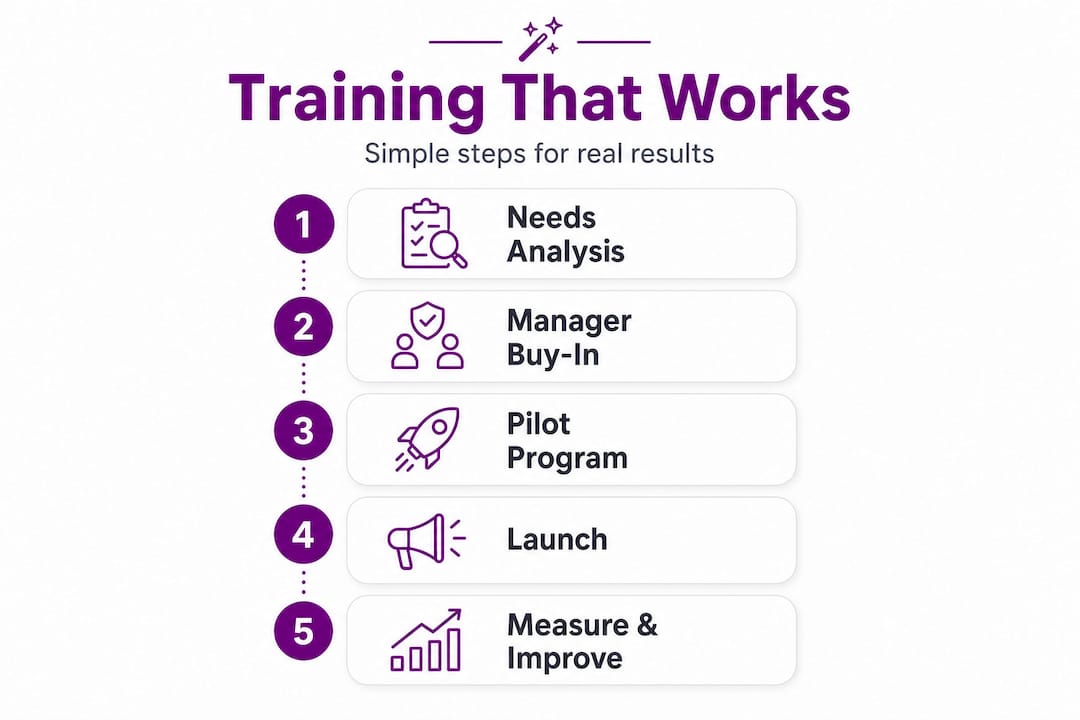
One of the most practical first steps is to conduct a training needs analysis (TNA) using performance reviews, surveys, and direct feedback to pinpoint real skill gaps. A TNA doesn't have to be formal. A simple one-page survey asking employees where they feel least confident, combined with a review of recent errors or complaints, gives you a solid starting point.
Here's a quick comparison of what you actually need versus what many small businesses think they need:
| What you think you need | What you actually need first |
|---|---|
| Expensive LMS software | Clear SOPs and documented job roles |
| Professional video production | Screen recordings or shadowing sessions |
| Dedicated L&D staff | A willing manager and a pilot group |
| Formal certification courses | Role-specific checklists and feedback loops |
| Full-time HR manager | A simple tracking spreadsheet or basic tool |
Pro Tip: Start with shadowing and SOPs before investing in any software. Two weeks of structured job shadowing paired with a one-page SOP often outperforms a $500 course for entry-level roles. Revisit onboarding best practices to see how other small teams are keeping it simple and effective.
Step-by-step: how to create a basic employee training program
With your prerequisites ready, you can move on to the concrete steps of building your program. This doesn't need to be complicated. Think of it as building a house: lay the foundation first, then add walls, then the roof.
-
Conduct a Training Needs Analysis (TNA). Review performance data, talk to managers, and ask employees directly. You're looking for patterns, not perfection. Three recurring complaints or errors usually point to one trainable gap.
-
Set SMART goals linked to your objectives. SMART stands for Specific, Measurable, Achievable, Relevant, and Time-bound. "Improve customer satisfaction" is not a goal. "Reduce customer complaint rate by 15% within 90 days of training rollout" is. Set SMART objectives aligned with business goals and design content using diverse methods like eLearning, hands-on practice, and mentoring.
-
Design bite-sized, engaging content. Nobody retains a three-hour lecture. Break content into 10-to-15-minute modules. Mix formats: short videos, written SOPs, role-play scenarios, and quick quizzes. Variety keeps people engaged and improves retention.
-
Choose the right delivery format for your team size. For small businesses, this often means shadowing, buddy systems, and SOPs rather than formal eLearning platforms. These methods are faster to set up, cheaper to maintain, and easier to personalize.
-
Implement with a pilot group first. Pick 2-3 employees to go through the program before you roll it out to everyone. Collect their feedback honestly. What was confusing? What was missing? What took too long? Fix those issues before the full launch.
-
Evaluate with pre- and post-assessments and KPIs. Measure what changed. Did error rates drop? Did new hires reach full productivity faster? Did compliance scores improve? You can't improve what you don't measure. For a practical look at how to structure these complete onboarding steps, the process is more connected than most people realize.
Here's a quick comparison of delivery formats to help you choose:
| Format | Best for | Cost | Setup time | Scalability |
|---|---|---|---|---|
| Job shadowing | Onboarding, hands-on roles | Free | Low | Low |
| SOPs and checklists | Compliance, process tasks | Free | Medium | High |
| Buddy system | Culture, soft skills | Free | Low | Medium |
| eLearning modules | Scalable skills training | Medium | High | Very high |
| Live workshops | Complex topics, teams | Medium | High | Low |
Pro Tip: Don't skip the pilot step. One small pilot saves you from rolling out a broken program to your entire team. Even a two-person test run surfaces problems you'd never catch on your own.
Special focus: onboarding, compliance, and skills development
The basics cover every training topic, but some areas require a little extra attention. Onboarding, compliance, and skills development each have unique requirements that affect how you design and deliver content.
Onboarding is not a one-day event. A single orientation session might check a legal box, but it rarely builds the confidence and competence a new hire needs to stay. Multi-month onboarding programs that include structured check-ins at 30, 60, and 90 days significantly reduce early turnover. Think of onboarding as a gradual handoff from "guided" to "independent," not a single information dump on day one.
Compliance training is where small businesses get into the most trouble. Most firms treat it as a once-a-year checkbox, and that's exactly when violations happen. Compliance training best practices include role-specific content, microlearning modules, interactive elements like quizzes and scenarios, just-in-time delivery, and regular refreshers throughout the year. Tracking completion is just as important as the training itself. If you can't prove an employee completed a required module, you're exposed during an audit.
A learning management system (LMS) or compliance tracking tool reduces your audit risk significantly. See how a compliance tracking case study shows what happens when a small firm finally gets this right, and why compliance and onboarding integration in one platform makes a real operational difference.
Skills development is the long game. For small businesses, the most effective approach is to blend formal training, coaching, and self-directed learning, with shadowing, SOPs, and weekly check-ins as the backbone. Formal courses work well for technical skills. Mentoring and coaching work better for judgment, communication, and leadership.

Here's a summary of how to approach each area:
| Training area | Primary method | Frequency | Key metric |
|---|---|---|---|
| Onboarding | Buddy system, structured check-ins | 30/60/90-day milestones | 90-day retention rate |
| Compliance | Microlearning, role-based modules | Ongoing with annual refresh | Audit pass rate, completion rate |
| Skills development | Shadowing, coaching, self-paced | Weekly check-ins, quarterly review | Time-to-proficiency, error rate |
"The biggest mistake small businesses make with compliance training is treating it as a one-time event. Ongoing, role-specific microlearning is what actually moves the needle on risk reduction."
Key reminders for each area:
- Onboarding: Assign a buddy, schedule formal check-ins, and don't front-load all information on day one
- Compliance: Track completion digitally, use scenarios over passive reading, and refresh content when regulations change
- Skills: Follow up every week, tie learning to real job tasks, and celebrate visible progress
Measuring and improving results
Building is just the start. Let's close with how you measure and grow success. A training program that isn't evaluated is just an expense. One that's measured and iterated becomes a competitive advantage.
The most widely used framework is the Kirkpatrick model. It evaluates training on four levels:
- Reaction: Did employees find the training useful and engaging? Use short post-training surveys.
- Learning: Did they actually gain knowledge or skills? Use pre- and post-assessments.
- Behavior: Are they applying what they learned on the job? Observe and track performance over 30-90 days.
- Results: Did the training move the business metrics that matter? Measure turnover, error rates, productivity, and compliance scores.
The Kirkpatrick 4-level evaluation framework is the gold standard for measuring training ROI across productivity, retention, and error rates. It works for small businesses too. You don't need sophisticated analytics software. A simple spreadsheet tracking the right KPIs gets you most of the way there.
Key KPIs to track from day one:
- Time-to-proficiency: How long does it take a new hire to work independently?
- Error rate: Are mistakes decreasing after training?
- 90-day retention: Are new hires still with you after three months?
- Compliance completion rate: What percentage of required training is completed on time?
- Productivity gains: Are output metrics improving quarter over quarter?
The training ROI data is clear: strong programs return $4.53 per $1 spent, and retention is 57% higher in organizations with a genuine learning culture. Those numbers are achievable for small businesses too, but only if you measure and iterate.
"You can't improve what you don't track. Even a basic before-and-after comparison of error rates tells you more than any post-training survey."
Use compliance management tools to automate tracking and stay audit-ready without adding manual work to your plate.
Why simple, practical training wins for small businesses
Here's a perspective that might push back on what you've read elsewhere: the most effective training programs for small businesses are almost never the most sophisticated ones.
I've seen small teams spend thousands on enterprise LMS platforms, only to have employees ignore the modules entirely because the content felt generic and disconnected from their actual jobs. Meanwhile, a 30-minute shadowing session with a senior team member, followed by a one-page SOP and a weekly check-in, produced measurable results within weeks.
Small business experts consistently favor zero-cost mentoring and shadowing over expensive seminars. The reason is simple: context. When training happens in the actual work environment, with real tasks and real feedback, it sticks. When it happens in a vacuum, it doesn't.
The "corporate training trap" is real. It's the assumption that more complexity equals more effectiveness. A 40-module eLearning course looks impressive in a board presentation. But if your team of six is skipping it because it takes three hours and doesn't reflect how they actually do their jobs, it's worse than useless.
What actually works for small teams:
- Pilot everything. Test with two people before rolling out to twenty.
- Personalize where you can. Generic training is forgettable. Role-specific training sticks.
- Iterate fast. If something isn't working after 30 days, change it. Don't wait for the annual review.
- Keep compliance and onboarding in one place. Fragmented systems mean things fall through the cracks. Unified tools like onboarding templates reduce the cognitive load on managers and HR teams.
The best training program you can build right now is the one your team will actually use. Start simple, measure honestly, and build from there.
How OnboardingGenie can help streamline your employee training basics
Ready to put these basics into practice? Here's how to take the next step with OnboardingGenie.
You've now got a solid framework for building an employee training program that actually delivers results. The challenge for most small businesses isn't knowing what to do. It's having the right tools to execute without adding hours of manual work to an already stretched team.
OnboardingGenie brings e-signatures, onboarding workflows, compliance tracking, and training management into one platform built specifically for small businesses. Whether you're looking for a DocuSign alternative for small business that doesn't charge enterprise prices, or you need compliance management features that keep you audit-ready year-round, the platform is designed to make the basics faster and easier to execute. Explore the full range of OnboardingGenie services and see how small teams are cutting onboarding time and compliance risk without adding complexity.
Frequently asked questions
What is a training needs analysis and why does it matter?
A training needs analysis identifies skill gaps by reviewing performance data, surveys, and direct feedback, ensuring your program addresses real business needs rather than assumed ones. Without it, you risk building training that misses the actual problem entirely.
How can a small business measure ROI on training?
Track productivity, error rates, and retention before and after training. Well-designed programs often deliver $4.53 per $1 spent, with retention rates 57% higher in companies with a strong learning culture.
How often should compliance training be updated?
Compliance training best practices call for ongoing microlearning and role-based refreshers throughout the year, not just an annual session. Update content whenever regulations change or audit findings reveal gaps.
What is the Kirkpatrick model and should we use it?
The Kirkpatrick model evaluates training on four levels: reaction, learning, behavior, and results. Yes, small businesses should use it. Even a simplified version gives you far more insight than relying on post-training surveys alone.