

Running a small business means wearing a lot of hats. Training coordinator is one most managers didn't sign up for, yet it's one of the most consequential roles you play. Schedule training too rarely and you end up with compliance gaps, outdated skills, and staff who feel unsupported. Schedule it too often and you disrupt operations, frustrate employees, and burn through budget. The good news? There's a practical, research-backed middle ground, and this guide will show you exactly how to find it.
Table of Contents
- Criteria: What determines the 'right' staff training schedule?
- Best practice schedules: Formal, skills, and compliance training
- Participation and effectiveness: How much is enough?
- Adapting your training: Trigger-based and situational refreshers
- The one mistake most managers make with training schedules
- Simplify your staff training and compliance with OnboardingGenie
- Frequently asked questions
Key Takeaways
| Point | Details |
|---|---|
| Layered scheduling | Combine onboarding, regular cycles, and event-driven refreshers for best training outcomes. |
| Quarterly and annual rhythms | Quarterly for skills/process, annually for compliance—and always adjust for critical changes. |
| Benchmark and adapt | Track participation and hours, and adapt frequency until results improve. |
| Trigger-based refreshers | Schedule extra training sessions after role changes, incidents, or compliance updates. |
| Deliberate follow-through | Don’t assume informal or optional training will stick—set and review a formal cadence. |
Criteria: What determines the 'right' staff training schedule?
Before picking a cadence, you need to diagnose what's actually driving your training needs. There's no universal answer, but there are clear factors that should shape your decision.
The most important variables include:
- Compliance requirements: Some industries have legally mandated training intervals. Missing them isn't just a performance issue, it's a liability.
- Skill decay rate: Technical skills fade faster than interpersonal ones. A customer service rep may retain communication skills for months, while a technician working with new software needs more frequent reinforcement.
- Staff experience levels: New hires need a stronger baseline. Seasoned employees need refreshers, not repetition of fundamentals.
- Regulatory triggers: Changes in law, new OSHA standards, or updated industry guidelines can reset the clock on training needs overnight.
- Recent incidents: A near-miss or compliance failure is a signal, not just a setback.
The smartest approach is a layered training structure: an onboarding baseline that every new hire completes, a regular cycle that keeps skills sharp, and event-driven refreshers that respond to real-world changes. Think of it like a three-tier system where each layer serves a different purpose.
"Training frequency should be layered with an onboarding baseline, regular cycles, and event-driven refreshers to match the pace of real operational change."
Common triggers that should prompt you to revisit your training schedule include role changes, process updates, new technology rollouts, regulatory shifts, and recent incidents. You can explore criteria for additional training and review real-world training triggers to see how other small businesses handle these moments.
Pro Tip: Tie your training review cadence to the operational metric you most want to move. If you're trying to reduce errors, review training effectiveness every time you audit error rates. The cadence should serve the outcome, not the calendar.
Best practice schedules: Formal, skills, and compliance training
Now that you understand what shapes your training needs, let's talk about what good schedules actually look like across different training types.
Quarterly formal sessions, monthly skill-building, and biannual product training are common benchmarks for non-compliance topics. Here's how to break that down practically:

| Training type | Recommended frequency | Notes |
|---|---|---|
| Onboarding | Once, at hire | Baseline for all staff |
| Formal/process training | Quarterly | Keeps systems current |
| Skills development | Monthly | Reinforced with practice |
| Product knowledge | Every 6 months | More often if product changes |
| Compliance (legal baseline) | Annually | Minimum, not maximum |
| Compliance refreshers | Quarterly or trigger-driven | After incidents or regulatory shifts |
Compliance training needs a yearly baseline at minimum, but smart managers don't stop there. Quarterly refreshers or trigger-driven sessions close the gaps that annual training leaves open.
A few practical points worth emphasizing:
- Annual compliance training is the floor, not the ceiling. If your industry is heavily regulated, quarterly check-ins are often more appropriate.
- Monthly skill-building works best when paired with on-the-job practice. A training session without reinforcement fades within days.
- Major incidents should automatically trigger an unscheduled session. Don't wait for the next quarterly cycle if something went wrong last week.
The connection between linking onboarding and compliance is often underestimated. When these two functions live in the same workflow, managers catch gaps much earlier.
Pro Tip: Build a simple training calendar at the start of each year. Block the mandatory compliance dates first, then layer in skills and formal training sessions. Leave at least two open slots per quarter for trigger-based sessions you can't predict yet.
Participation and effectiveness: How much is enough?
Knowing the recommended schedule is one thing. Understanding how real organizations perform against benchmarks is another, and the data here is sobering.
Median 8 hours per year is what most organizations spend on learning and development per full-time employee, and only 25% of employees complete non-mandatory training. That's a significant participation gap, especially for small businesses where every team member's skills directly affect outcomes.
The trend is moving in the wrong direction. Average formal learning hours per employee in 2024 dropped to 13.7, down from 17.4 in 2023. When formal learning hours shrink, the quality and targeting of each session matter even more.
Here's a comparison of where organizations stand versus where they should be:
| Metric | Industry benchmark | Recommended target |
|---|---|---|
| Annual learning hours per employee | 8 to 13.7 hours | 16 to 24 hours |
| Compliance training completion | Varies by industry | 100% mandatory |
| Non-mandatory training completion | 25% | 70%+ |
| Quarterly training review | Rare | Standard practice |
The gap between actual and recommended is real. But closing it doesn't require a massive budget overhaul. It requires deliberate scheduling and accountability.
Here's a simple action plan:
- Track actual results. Know how many hours each employee spends in training per quarter, not just per year.
- Review your cadence quarterly. Ask whether the schedule is still serving your current team size, roles, and compliance needs.
- Adjust for gaps. If participation is low, investigate whether timing, format, or relevance is the barrier.
"Cadence without measurement is just a guess. The managers who improve training outcomes are the ones who treat their schedule as a living document, not a set-and-forget plan."
For a practical look at how small firms handle this, the approach to small firm compliance tracking offers useful real-world context.
Adapting your training: Trigger-based and situational refreshers
Scheduled training is essential. But some of the most important training moments aren't on the calendar.
OSHA's "at least annually" standard doesn't mean once a year is always enough. If roles change, procedures are updated, or regulations shift, more frequent retraining is required, regardless of when the last session occurred. The legal standard is a minimum, not a permission slip to skip additional training.
Here's a numbered process for identifying when to trigger an off-cycle refresher:
- Identify the change. New regulation, updated process, new tool, or incident.
- Assess who is affected. Not every change requires whole-team retraining. Target the right roles.
- Determine urgency. Compliance changes are immediate. Skill updates can often wait for the next scheduled window.
- Schedule and document. Off-cycle sessions still need records. Undocumented training is invisible during audits.
- Follow up. Check comprehension within two weeks of the session.
Situations that almost always demand extra training include:
- A regulatory update affecting your industry
- A workplace incident or near-miss
- A significant technology or process change
- A new hire joining mid-cycle who missed onboarding sessions
- An audit finding that reveals a knowledge gap
- A role transition or promotion
Understanding when to schedule extra sessions and knowing what lies beyond digital signatures in a complete compliance workflow helps managers see the full picture of what effective training management actually involves.
The one mistake most managers make with training schedules
Here's an uncomfortable truth: most managers treat their training schedule as a compliance checkbox rather than a performance tool.
They set up an annual compliance session, maybe a quarterly skills workshop, and then they leave it alone. The calendar repeats itself year after year, regardless of whether the team has grown, roles have shifted, or the training is actually landing. The schedule becomes a ritual instead of a strategy.
I've seen this pattern repeatedly. A manager builds a solid training plan in January, feels good about it, and then spends the rest of the year executing it without questioning whether it's still the right plan. By Q3, the team has changed, the business has changed, and the training hasn't kept up. The gap between what employees know and what they need to know quietly widens.
The fix isn't more training. It's smarter feedback loops. Build a quarterly review into your process where you ask one simple question: is this rhythm still working? Look at error rates, compliance incidents, employee feedback, and skill gaps. Let the data tell you whether to increase frequency, change format, or shift focus entirely.
Managing compliance and onboarding in the same system makes this kind of review dramatically easier because you can see patterns across the entire employee lifecycle, not just isolated training events.
Flexibility isn't a weakness in a training plan. It's the whole point.
Simplify your staff training and compliance with OnboardingGenie
Getting your training cadence right is only half the battle. The other half is having a system that makes it easy to execute, track, and adapt without drowning in spreadsheets or chasing down signatures.
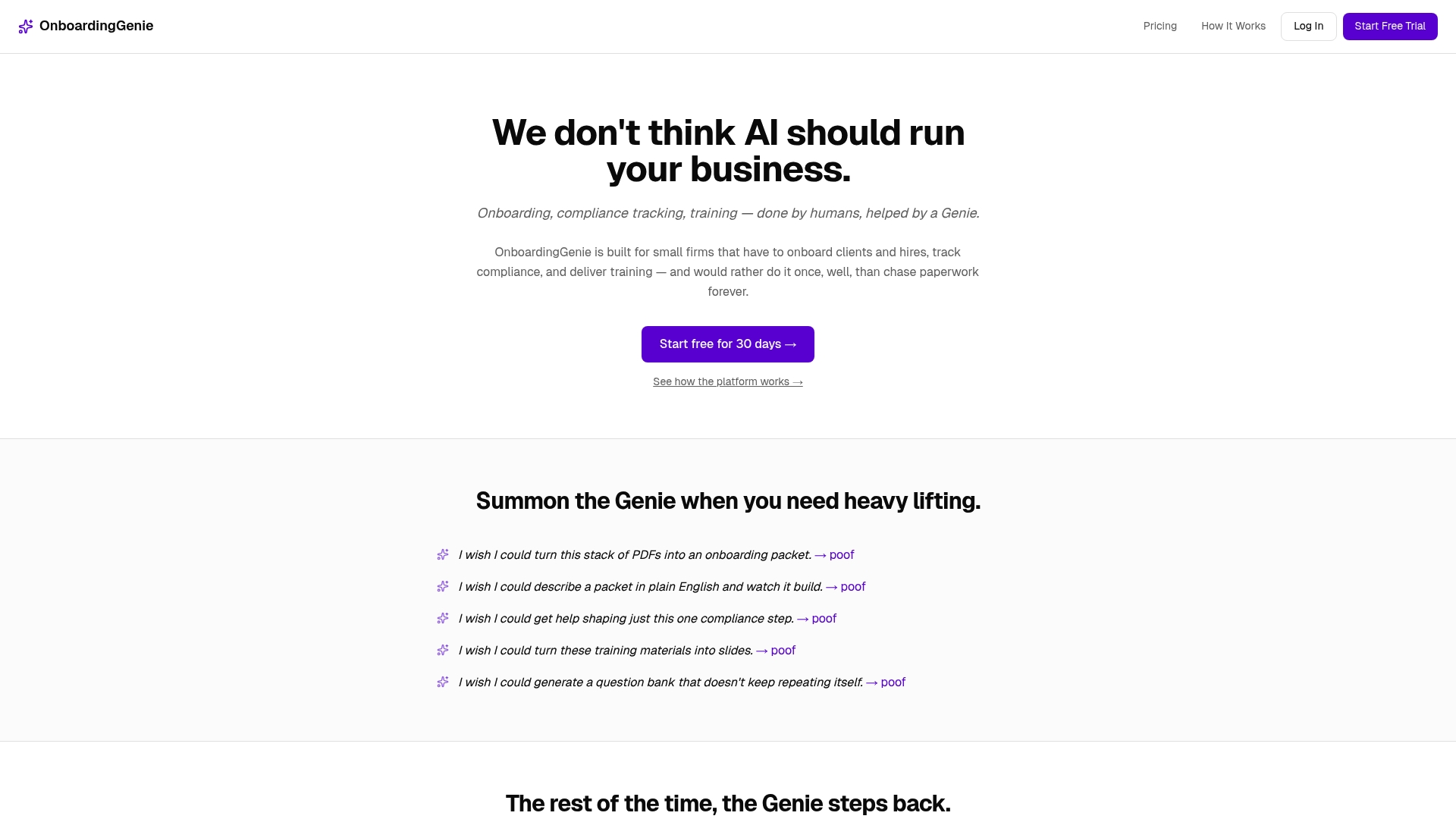
OnboardingGenie brings together e-signatures, onboarding workflows, compliance tracking, and training management in one platform built specifically for small businesses. Whether you're running scheduled quarterly sessions or responding to a sudden regulatory change, you can manage it all without switching between tools. Explore our training and onboarding services to see how it fits your workflow, or check out our AI onboarding templates to get started faster than you'd expect.
Frequently asked questions
How often should staff training be updated?
Staff training should be updated at least annually for compliance topics, with additional sessions scheduled after incidents, role changes, or regulatory updates. Annual is the floor, not the target.
What is the typical time commitment for non-compliance training each year?
Most organizations provide between 8 and 13.7 hours per employee annually, though the 2024 ATD benchmark shows a downward trend that makes deliberate scheduling more important than ever.
What triggers make extra training necessary outside of regular schedules?
Regulatory changes, significant incidents, new technology rollouts, or major role transitions all require off-cycle refreshers that can't wait for the next scheduled window.
How do I know if training frequency is moving the metrics I want?
Align your review cadence with the business outcomes you're tracking, such as error rates, compliance incidents, or productivity, and adjust your training schedule based on what the data shows.