

Most small business owners assume compliance is a background task, something you handle once a year and forget about. That assumption is expensive. Small businesses spend 20+ hours per month on compliance activities alone, time that could go directly into revenue-generating work. When you factor in the penalties, legal exposure, and reputational damage that come from getting it wrong, compliance stops being a background task and starts looking like one of the biggest financial risks in your business. The right tools change that equation completely.
Table of Contents
- The real cost of compliance (and non-compliance)
- Why manual compliance often fails (and how automation changes the game)
- Automation and ROI: What the data shows
- From burden to advantage: How compliance tools enable growth
- Why the biggest compliance risk is sticking with 'what worked last year'
- Next steps: Protect your business and simplify compliance
- Frequently asked questions
Key Takeaways
| Point | Details |
|---|---|
| Compliance costs add up | Failure to manage compliance can multiply costs and risks for small businesses. |
| Manual tracking is risky | Old methods like spreadsheets often lead to costly errors and penalties. |
| Automation delivers high ROI | Modern compliance tools save labor and cut errors, paying for themselves many times over. |
| Tools enable growth | Smart compliance solutions turn a burden into an advantage, freeing owners to scale their business. |
The real cost of compliance (and non-compliance)
Having set the stage for why compliance is critical, it's essential to quantify what non-compliance can cost your business. Most owners think about compliance in terms of time. But the real number that should keep you up at night is the penalty multiplier.
Here's the hard truth: compliance costs SMBs 1-3% of revenue in regulated industries. That sounds manageable. But non-compliance? That runs 5 to 10 times more expensive than staying compliant in the first place. A single OSHA violation can generate a $34,000 fine, and that's before you factor in legal fees, lost contracts, and the reputational damage that follows a public compliance failure.
"The cost of non-compliance is not just financial. It touches your reputation, your vendor relationships, and your ability to win new business."
What most owners overlook is the hidden cost stack. It's not just the fine itself. It's the attorney you hire to respond, the audit hours your team spends pulling records, the contract you lose because a client ran a compliance check on you and found a gap. These compliance management risks compound quickly.
Costs you're probably not tracking:
- Time spent manually gathering and updating compliance records
- Employee hours lost to redundant paperwork and re-verification
- Delayed onboarding because documents weren't ready or signed
- Contracts lost to competitors who could demonstrate cleaner compliance records
- Insurance premium increases tied to compliance incidents
Here's a quick comparison to make this concrete:
| Scenario | Estimated annual cost |
|---|---|
| Proactive compliance with tools | 1-3% of revenue |
| Non-compliance (fines, legal, lost deals) | 5-10x compliance cost |
| Manual compliance management (labor only) | $8,000-$20,000+ per year |
| Automated compliance platform | $1,200-$4,800 per year |
The numbers make the case clearly. Staying compliant with the right tools is not just safer. It's dramatically cheaper than the alternative.

Why manual compliance often fails (and how automation changes the game)
Understanding these costs, let's look at why most owners' current compliance methods fall short and what shifts when you automate.
Most small businesses manage compliance the same way they managed it five years ago: spreadsheets, shared folders, sticky notes, and a calendar reminder that someone set up and nobody updates. It feels like a system. It isn't.
Manual tracking fails most often due to staff turnover, with SBA data showing 34% of compliance penalties tied directly to degraded or abandoned spreadsheet systems. When the person who built the tracking sheet leaves, the institutional knowledge leaves with them. The next person inherits a spreadsheet they don't fully understand, and errors start accumulating silently.
These law firm spreadsheet pitfalls are a perfect example. A firm tracks client matter deadlines manually. One associate leaves. Another takes over and misreads a date format. A filing deadline is missed. The firm faces a malpractice claim. The spreadsheet didn't fail dramatically. It failed quietly, the way most manual systems do.
The four most common ways manual compliance breaks down:
- Version control failures. Multiple people update different copies of the same document, and nobody knows which is current.
- Deadline drift. Renewal dates get pushed back in a calendar, then forgotten entirely when the person who set them is on vacation or has left the company.
- Incomplete records. Auditors ask for documentation from 18 months ago, and it simply doesn't exist in a retrievable format.
- No audit trail. When something goes wrong, you can't prove what happened or when, which makes defending yourself nearly impossible.
These manual compliance mistakes are not edge cases. They're the norm for businesses relying on legacy tools.
Automation changes the game by removing the human single point of failure. A good compliance platform tracks deadlines automatically, sends alerts before they lapse, stores documents in a searchable and auditable format, and creates a clear record of who did what and when. The system doesn't take vacations. It doesn't forget. It doesn't misread a date.
Pro Tip: Before you evaluate any compliance tool, map out every place in your current process where a single person's absence could cause a failure. Those gaps are your highest-risk points and your best argument for automation.
| Feature | Manual (spreadsheet) | Automated compliance tool |
|---|---|---|
| Deadline tracking | ❌ Prone to human error | ✅ Automated alerts |
| Audit trail | ❌ Incomplete or missing | ✅ Full timestamped log |
| Staff turnover resilience | ❌ Knowledge walks out the door | ✅ System retains all data |
| Document storage | ❌ Scattered across folders | ✅ Centralized and searchable |
| Scalability | ❌ Breaks under growth | ✅ Scales with your business |
Automation and ROI: What the data shows
Now that we see why manual systems fail, it's time to quantify how much a modern tool can improve compliance costs and efficiency.
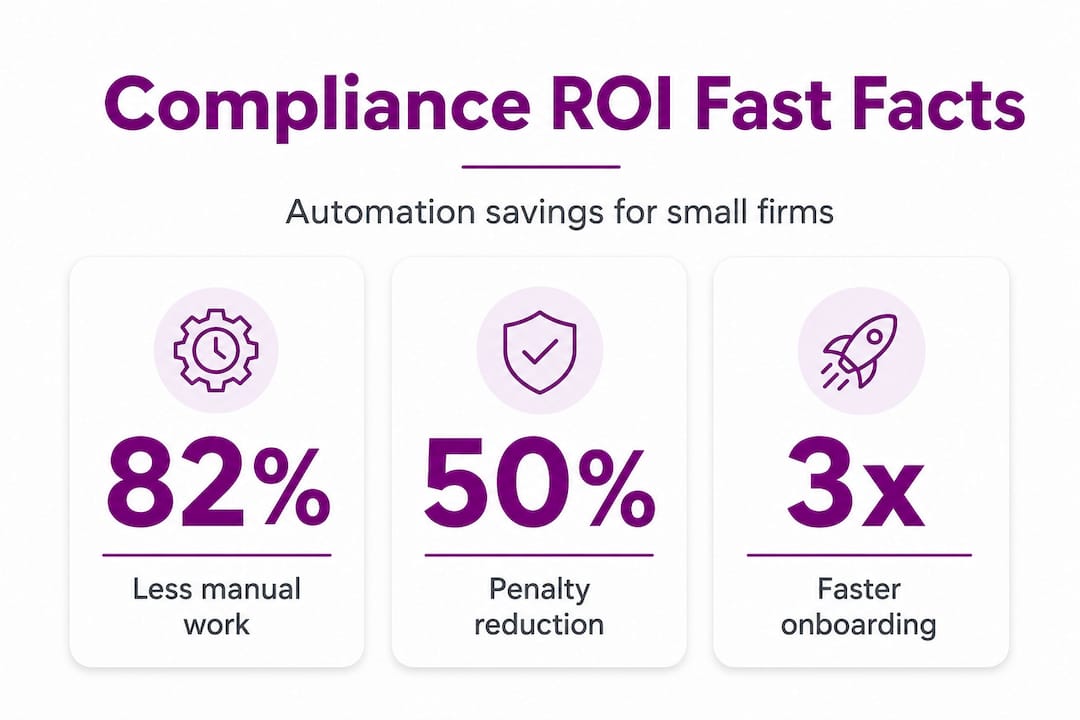
The ROI numbers for compliance automation are not subtle. According to Gartner and SBA benchmarks, businesses that adopt compliance automation see labor reductions of up to 82% and ROI ranging from 640% to 1,358%. That's not a rounding error. That's a fundamental shift in how much of your team's time goes toward keeping the lights on versus growing the business.
Let's break that down practically. If your team currently spends 20 hours per month on compliance tasks at an average loaded labor cost of $35 per hour, you're spending roughly $8,400 per year just on the manual work. An 82% reduction brings that down to about $1,500 in labor, plus the cost of the tool itself. Most small business compliance platforms cost far less than the labor savings they generate in the first year alone.
Where the savings actually come from:
- Automated document collection and reminders eliminate hours of follow-up emails
- Pre-built templates reduce the time spent creating and formatting compliance documents
- Centralized tracking replaces the time spent searching across folders, inboxes, and shared drives
- Automated alerts prevent the costly scramble that happens when a deadline is missed
- Audit-ready records eliminate the hours spent reconstructing documentation during reviews
Take remote I-9 automation as a specific example. A consulting firm with remote hires used to spend 45 minutes per new employee on I-9 Section 2 verification, coordinating across time zones, chasing documents, and manually logging completions. With automation, that process dropped to under five minutes per hire. Multiply that across 30 hires a year and you've recovered over 20 hours of HR time annually from a single compliance task.
Pro Tip: After your first 90 days using a compliance tool, pull a report on missed deadlines and labor hours saved. Compare it to your baseline. That number becomes your internal ROI case, and it's usually more compelling than any vendor estimate.
The financial return is real, but the risk reduction is equally valuable. Fewer missed filings means fewer penalties. Cleaner records mean faster audits. Documented processes mean smoother transitions when staff changes.
From burden to advantage: How compliance tools enable growth
With automation quantified, let's explore how strategic compliance tools give owners an edge over competitors.
Here's the mindset shift that separates growing businesses from stagnant ones: compliance is not just about avoiding penalties. It's about building the kind of operational credibility that wins contracts, attracts talent, and supports scaling without chaos.
Proactive compliance automation enables growth without added headcount. That's the key insight. You don't need to hire a compliance officer or a dedicated HR manager to stay on top of regulations. The right platform handles the tracking, the alerts, the documentation, and the audit trail, so your existing team can focus on work that moves the business forward.
How compliance tools create competitive advantage:
- Faster onboarding. When compliance and onboarding live in the same system, new hires move through paperwork, training, and verification in a fraction of the time. That means faster time-to-productivity and a better first impression.
- Contract readiness. Enterprise clients and government contractors increasingly require compliance documentation before signing. Businesses with clean, accessible records win those contracts. Businesses scrambling to pull records together often don't.
- Reputation protection. A compliance incident is public in ways that didn't exist a decade ago. Protecting your record protects your brand.
- Scalability without proportional cost. Adding five new employees shouldn't mean five times the compliance paperwork. Automation keeps the overhead flat as you grow.
The compliance and onboarding integration point deserves extra attention. When these two functions are separated across different tools, things fall through the cracks. An employee might complete onboarding paperwork but miss a required training. Or a document gets signed but never verified. Combining them in one platform creates a single source of truth that's both more reliable and easier to manage.
Pro Tip: Map your current onboarding checklist against your compliance requirements. Wherever they overlap, that's where a unified platform saves you the most time and reduces the most risk.
The businesses winning in competitive markets right now are not the ones with the most resources. They're the ones running the tightest operations. Compliance tools are a core part of that tightness.
Why the biggest compliance risk is sticking with 'what worked last year'
I want to say something that most compliance articles won't tell you. The biggest risk in your compliance program is not a new regulation or a surprise audit. It's the assumption that because nothing went wrong last year, nothing will go wrong this year.
That assumption is comfortable. It's also how most compliance failures happen.
Think about what actually changed in your business over the last 12 months. Did you hire anyone new? Did someone leave who owned a critical process? Did you add a service line, open a new location, or take on a client in a different state? Each of those changes carries compliance implications. And if your process is the same spreadsheet you've been using for three years, none of those changes are being tracked systematically.
Automation benchmarks show that the highest-risk scenarios are not complex regulatory environments. They're simple turnover and vacation scenarios where a single person's absence breaks the entire tracking chain. That's a solvable problem. It just requires acknowledging that your current process depends on people rather than systems.
The software lessons for small firms are instructive here. Many owners invest heavily in tools that solve one part of the problem, like e-signatures, while leaving the rest of the compliance workflow completely manual. The signature works. Everything around it doesn't. That's the gap that creates real exposure.
Investing in a modern compliance platform is not a luxury. It's a lower-risk, higher-return alternative to hoping your current process holds up under pressure. The data supports it. The real-world failures of manual systems confirm it. The only thing standing between most small businesses and a better compliance outcome is the inertia of doing what they've always done.
Next steps: Protect your business and simplify compliance
Ready to apply what you've learned? Here's how to put modern compliance tools to work for your business.
If you've been running compliance on spreadsheets, shared folders, or a patchwork of disconnected tools, you already know the friction. The follow-up emails, the missed deadlines, the scramble before an audit. That doesn't have to be your normal.
OnboardingGenie brings compliance management, e-signatures, onboarding, and training into one platform built specifically for small businesses. No more juggling three tools to accomplish one workflow. No more hoping the person who built your tracking spreadsheet is still around to explain it. You get automated alerts, auditable records, and a streamlined onboarding experience that keeps your team moving and your business protected. Explore the full range of onboarding and training solutions and see how quickly you can replace complexity with clarity.
Frequently asked questions
What is a compliance tool for small business owners?
A compliance tool helps businesses track legal requirements, automate filings, avoid fines, and streamline onboarding processes. The best platforms combine these functions in one place, with automation reducing compliance labor by up to 82% compared to manual methods.
How much time can compliance automation really save?
Automation can reduce compliance labor by up to 82%, cutting manual tracking, document chasing, and deadline management dramatically across the board.
What are the biggest risks of manual compliance management?
Manual methods create single points of failure tied to individual employees, and 34% of compliance penalties trace back to degraded spreadsheet systems, especially after staff turnover.
How do compliance tools help small businesses grow?
They shift compliance from reactive burden to proactive advantage, freeing owners to scale operations, win more contracts, and onboard new hires faster without adding overhead.
What can happen if a business is non-compliant?
Non-compliance can result in fines, legal fees, and lost contracts, with a single OSHA violation running $34,000 or more before any legal costs are added.